Landscaping around a custom Australian pool
The garden is a debris machine and a root system sitting beside a concrete shell. Plant for leaf load, sightlines and western shade, not for a resort photograph.
Custom Pools editorial team · 18 January 2026 · Updated 2 February 2026 · 17 min read
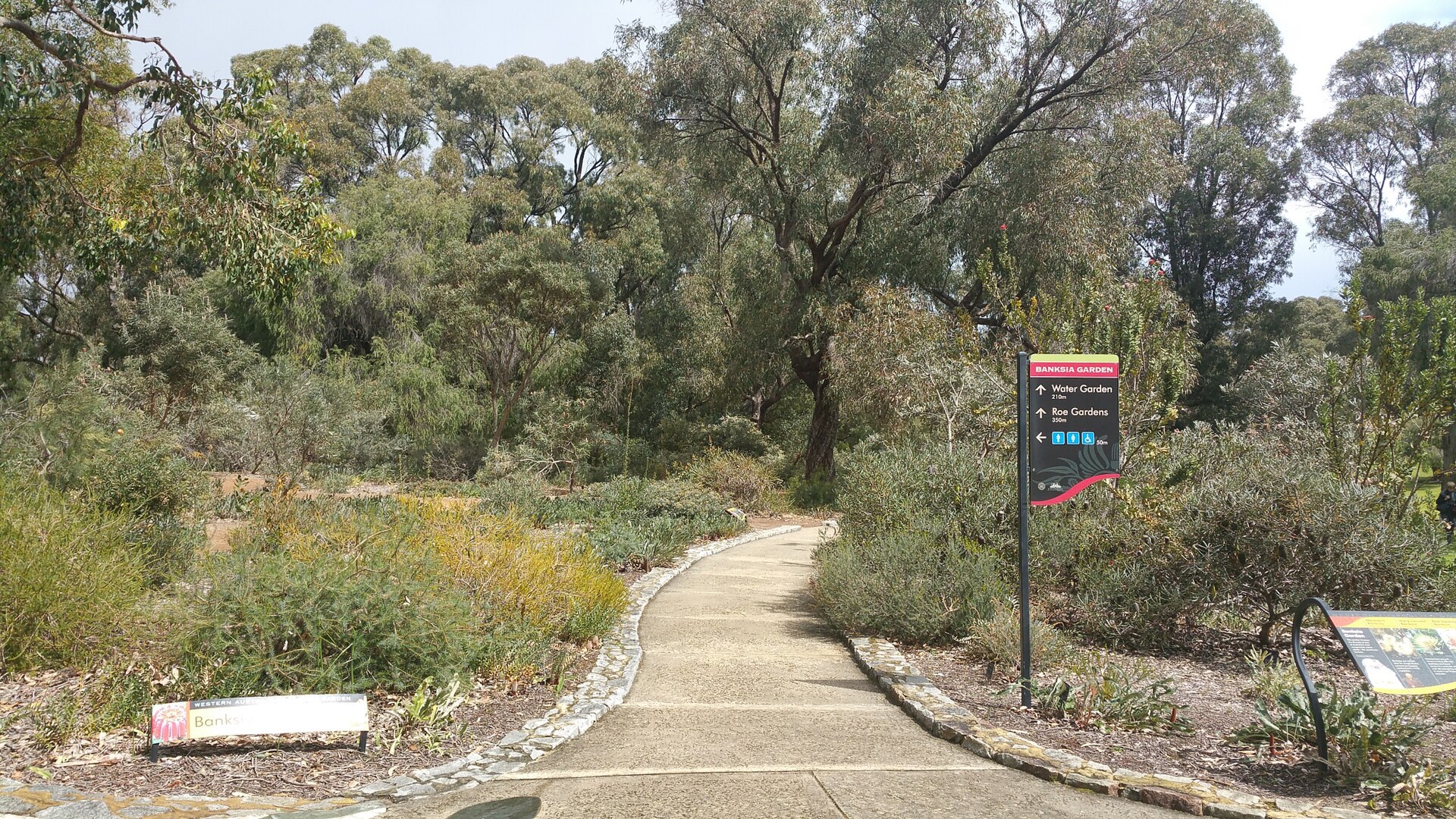
Photo: Gnangarra / Wikimedia Commons, CC BY 2.5 AU · See the image credits page.
A custom pool sits in a garden, not in a showroom. The garden will drop leaves into the weir, push roots at the shell, throw shade where you wanted sun, and hide a child from the kitchen window if you let it. Australian planting is a choice about debris, roots and the western afternoon — not a resort kit and not a bare court with one pot.
The outdoor living hub exists because the water is only half the room. Landscape as if the plants will still be there when the pebble is due for a refinish. Most of them will, and they will be larger than the drawing.
Leaf load is a hydraulic problem
Every leaf is a pump problem. Skimmers and wet-edge troughs are leaf machines. A deciduous exotic over a Melbourne pool gives you an autumn in bags. A melaleuca that looks “native and fine” gives you a year-round tea of stamens. A messy palm on a tropical block gives you fronds no domestic cleaner was designed to swallow. In Queensland that is also a wet-season problem: more growth on the days you least want to be out there.
Plant the messy species away from the skimmer and downwind if you can. A clean-canopy tree to the west will do more for water quality than a more expensive sanitiser. If you want flowers, accept a season of petals and put a leaf basket where you can reach it.
Roots, shells and the quiet structural failure
Trees and large shrubs explore wet soil. A shell, a pipe run and a paving bed are all interesting to a hungry root. Paperbarks, figs, willows and a few “fast screens” have a reputation that is earned. They do not belong over a pipe you will need to dig up.
This is an argument for species and setback, not for a treeless yard. Keep the first metre or two outside the shell as paving, gravel or a shallow strip you are willing to replace. Bamboo is a screen owners love until it is a neighbour’s affidavit. If you must have it, contain it, and keep it out of the non-climbable zone.
Natives and exotics, without the slogan
Natives are not automatically low-mess. A local banksia can be right on a Perth sand lot and wrong over a skimmer. A lilly pilly hedge can screen and can also become a climbable, fruit-dropping wall. Choose the plant for the job, then check the mess and the root.
Exotics still earn a place. A frangipani on a Sydney north fence is a summer smell. An olive on a dry Adelaide court is a grey cloud and an oily fruit if you do not pick. None of these are crimes; putting them where the fruit falls into a wet deck is. Match the planting to the rainfall you will actually give it. A “tropical” mix on a Melbourne brick wall will look like a florist’s bucket in January and sticks in August. The pool does not make the climate optional.
Lawn, gravel and the band beside the stone
Lawn to the water is an old Australian picture and a constant argument with the mower. Fertiliser and clippings end up in the pool; the wet edge of the lawn yellows. A hard band of coping and paving, then lawn beyond, is the pattern that lasts.
Gravel is honest on a dry court. It needs an edge that stops stone migrating into the skimmer. Planted joints look soft and make weeding a hobby. Sterile paving with a planted bed beyond is easier to live with than a meadow you step through with wet feet.
Irrigation that does not swim
Overspray is how landscape contractors fertilise a pool. Sprinklers aimed at a lawn will also aim at a glass fence, a coping joint and the water. Use drip in the beds beside the pool, or use a low throw you have tested on a windy afternoon. Put the controller on a brain that can skip a day after rain so you are not watering a full pool with a hose that also hits the pebble.
Bore water and some town supplies stain stone and interiors. If the irrigation drips onto a pale travertine, you will see it. Design the wet side of the garden to be rinsed or to be a material that can take the mark.
Do not run a pop-up in the non-climbable zone where it becomes a foothold, and do not put a tap where a child can stand on the riser to reach the fence.
Western shade without a leaf tunnel
The western sun is the enemy of January use. A tree or a structure that takes the 3pm hit off the coping will keep people in the water. The tree must have a canopy you can lift and a litter you can accept. A deciduous exotic on a Melbourne west fence can be perfect: shade in February, light in July. A cabana roof does the same job with more certainty. Do not plant a dense screen on the north in a southern capital and then wonder why the pool is cold. Orientation belongs with the plant list.
Sightlines, supervision and the pretty hedge
A garden that hides the water from the house is a pretty garden and a worse one to supervise. If children will use the pool, the kitchen or the room you actually sit in needs a view of the surface. That does not mean a bare rectangle. It means the planting in the sightline stays low, and the taller plants sit to the sides.
The barrier has a non-climbable zone. Plants are how households accidentally defeat a legal fence — a bench, a pot, a growing hedge, a stack of pool toys against the glass. Landscape drawings should show the zone and the mature size, not the nursery pot. If a plant will become a ladder, it is the wrong plant.
Pots are not exempt. A heavy pot against a glass panel is a step. A row of cubes can be a stair. Place them as if a certifier will come back in three years, because in some states they will.
The garden as the rest of the room
Link the pool to the house with the same materials and the same plants the front garden already believes in, or make a deliberate change and then commit. A resort kit dumped behind a Federation house looks like a resort kit. A dry, local palette around a dark court can look like the block always wanted a sheet of water.
Think about night. The planting will sit in light or in silhouette. A pale trunk against a dark interior is a drawing. A messy shrub in front of a niche is a shadow puppet.
Think about service. Someone has to get a trolley to the plant room, empty a leaf basket, and lift a lid. A garden that blocks every access path is a garden that will be trampled.
When the plant list is honest — leaf, root, water, shade, sightline — the pool can sit in an Australian garden rather than in a cleared compound. That is the work of this hub: cabanas, fences, smaller water, and the planting that makes the expensive hole feel like a place. Read the rest of outdoor living as one room, and put the trees where the western sun and the skimmer can both live with them.
Photo: Gnangarra / Wikimedia Commons, CC BY 2.5 AU
Questions readers ask
- What should I plant against a pool fence?
- Something that will not become a climbable ladder, will not drop a sticky mess on the coping, and can be kept without leaning over the water every weekend. Low, clump-forming natives and a few well-chosen grasses beat a hedge that wants to be two metres thick. Keep the non-climbable zone honest.
- Are native plants better beside a pool?
- Often, because they match the rainfall and they look like the rest of the street. They are not automatically tidy. Some banksias and eucalypts drop more than a frangipani. Choose species, not a slogan, and favour clean canopies on the western side.
- Can I keep a lawn up to the coping?
- You can, if you like mower spray, fertiliser in the skimmer and a wet, compacted strip that dies in January. A hard band of paving or gravel, then lawn beyond, is kinder to the water and to the grass. If you want the lawn-to-water look, design the fall and the mowing edge as a detail, not as an accident.
Found an error? Use the contact form or read how we handle corrections in editorial standards.