Lighting a custom pool after dark
Underwater light is a piece of electrical work in a drowning hazard. Colour, glare and neighbour amenity matter as much as the glow in the photograph.
Custom Pools editorial team · 12 November 2025 · Updated 2 December 2025 · 19 min read
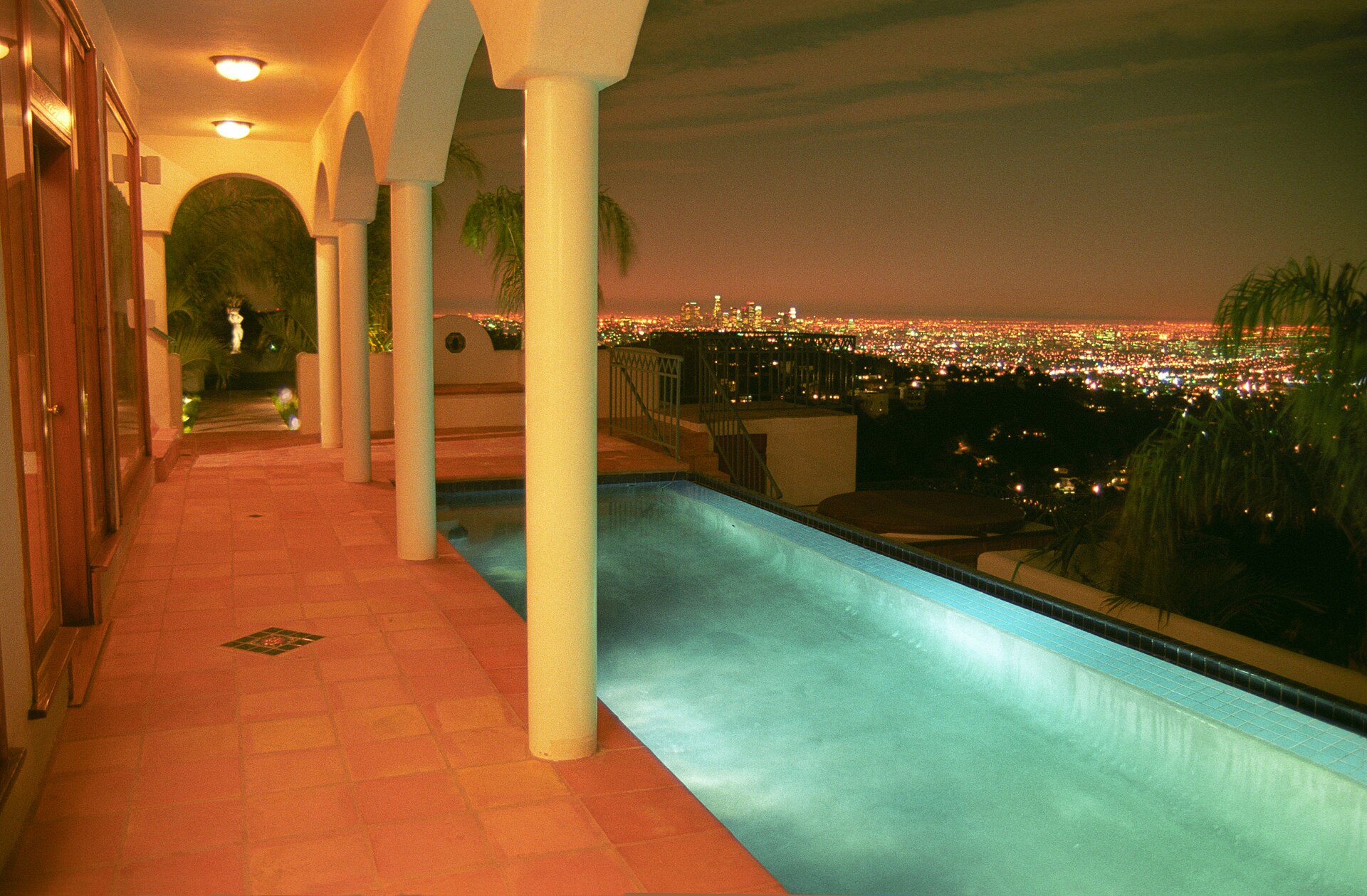
Photo: Downtowngal / Wikimedia Commons, CC BY-SA 4.0 · See the image credits page.
A pool after dark is a different room. The water becomes a volume of light or a black hole. Steps disappear. Neighbours who never notice the pool at noon will notice a colour wash on their bedroom ceiling. Lighting is electrical work, optical work and manners — not a pair of spots ordered when the pebble is already in.
Australian work sits under AS/NZS rules for water features and extra-low voltage equipment, under state licensing, and under the same seriousness as the barrier. Hire a licensed electrician who has done pools. Do not let a landscaper “just run a garden transformer” into a niche.
What the light is for
Write the uses before you pick a fitting. A household that swims at 8pm in January wants the floor, the steps and the bench to be honest. A household that looks at the water from the kitchen wants a calm surface and no lamp in the eye. A household that entertains twice a summer wants a scene they can turn off. Those are different aiming diagrams.
Underwater light does not replace path light. A glowing pool beside a dark run of paving is how people step off a coping. The outdoor kitchen and cabana need their own layers — bench light, a downlight under a roof, a dim path. The garden needs enough light to walk without turning the yard into a sports field. Think in layers, then put the brightest layer in the water only if the water is where the feet are going.
Niche lights in concrete
Cast-in niches are still the standard way to put a serious lamp in a concrete shell. Conduit, potting, bonding and the transformer location are first-pour decisions. Once the steel is in, moving a light is an argument with the engineer.
Place niches on the side you will not sit and stare from. A lamp opposite the living room, aimed at the sofa, is a glare machine. On a simple suburban rectangle, one or two lamps on the house side, firing toward the far end, often do the job. A dark interior eats light; a pale pebble throws it around.
Niches want a setout the interior finish can meet. A pebble thickness is not a mosaic thickness. Coordinate with the interior and the waterline before the pour. Fibreglass shells come with factory positions; custom concrete is a chance to get this permanently right or wrong.
LED, colour and white
Almost everything new is LED. The choice is white, tunable white, or colour. Warm white — a dining room, not a carpark — is what most people still want on a Tuesday. Cool white makes the water look like a municipal night swim.
Colour is a tool. A deep blue on a dark interior can look like a night court. A shifting rainbow on a family pool in a tight terrace looks like a takeaway shop. If you buy colour, set a decent white as the default and treat saturated colour as an event. If you will not learn the app, buy white. Specify dimming, and a night scene dimmer than the handover demonstration.
Glare, wet decks and the infinity edge
Glare is the usual failure. A fitting aimed at a glass fence becomes a row of lamps in the street. A fitting aimed at a wet edge can turn the weir into a glitter strip or, if it is in the wrong place, into a black wall with a bright hole. Walk the sightlines from the house, from the neighbour’s upper window if you can guess it, and from the street.
Wet decks and shallow shelves need light that reads the floor, because people will walk there at night. A single deep-end lamp will not do that. It will make the shelf a dark apron around a glowing hole. Either light the shelf, or keep people off it after dark with a change of level and a path that does not invite the shortcut.
Do not light the water so hard that the garden disappears. The pool should sit in the yard, not bleach it.
Neighbour amenity
Australian suburbs are close. A colour wash on a boundary fence is a dispute. So is a bright niche that fires through a glass barrier into a bedroom. So is a late-night spa scene with a spill and a rotating LED.
Aim into the block. Use shields and coping overhangs. Put the controller on a timer that dies before midnight unless someone overrides it. If the barrier is glass, treat every underwater lamp as a potential beacon. This is manners, and in some councils it is also a condition waiting to be written after a complaint.
Path lights on a boundary should be low, warm and few. They are for walking, not for displaying the new pool to the street.
Transformers, cables and the plant room
Extra-low voltage lighting still needs a transformer or driver, a circuit that is protected, and a place that stays dry and serviceable. That place is often the plant room. Do not hide a driver in a soaked pit behind the filter because the cabana joinery was already full. Do not bury a junction where the only access is to empty the pool.
Cables through the shell must be the cables the system was designed around, run in the conduits that were cast. After-the-fact chasing of a concrete beam is how waterproofing fails. Bonding and equipotential requirements are the electrician’s and the builder’s job; your job is not to wave them away because a friend “never bothered”.
Leave isolation and labelling that a future technician can understand. Pools outlive the first electrician’s phone number.
Fibre and the other ways to cheat
Fibre-optic perimeter lighting still has a place on a feature wall or a step nose. It can mark an edge; it does not make a deep end safe if people will swim. Surface-mounted retrofit lamps exist for renovations and are a compromise. If you are building new concrete and night use matters, pay for niches in the pour. Solar floating lights are clutter with a battery.
Path lighting versus underwater lighting
The most useful night work on many sites is not in the water. It is a warm downlight under the pergola, a low path light on the route from the kitchen, a tread light on the stairs beside a slope, and a modest lamp at the gate latch so a guest can find the lock. Underwater light then becomes a volume you look at, not the only source you steer by.
Coordinate the two. If the path is lit and the water is dark, the pool is a hole. If the water is lit and the path is dark, the coping is a trip. A single design, one set of warm temperatures, and a dimmer for each layer will look like a house. A collection of bright white garden spikes and a colour-changing niche will look like a trade show.
On a slope or a wet-edge terrace, the path is also a safety system. Treat it with the same seriousness as the fence.
Standards, licensing and what not to invent
Pool and spa electrical work in Australia is licensed work. AS/NZS rules cover extra-low voltage luminaires, clearances and residual-current protection. This essay will not invent a wiring method. Use a licensed electrician who lists pools as ordinary work, not as a favour. Do not instruct anyone to “leave the bonding for now”, or to run a mains fitting where an extra-low voltage fitting belongs. Failures here are shock, not a dull finish. If the house is being built at the same time, put the pool circuits on the electrical drawings with the rest of the wet area.
Commission the night, not only the day
Handover is usually in daylight. Insist on a dusk visit. Stand in the kitchen, on the coping, and at the neighbour’s side if you can do so politely. Dim the scene until the steps are still readable and the living room is not in glare. Save that scene. Then walk the path to the cabana and fix whatever is still a black hole.
Lighting belongs with the other finishes in the materials hub because it changes the colour of pebble, mosaic and stone. It also belongs with the plant room and the manners of a suburb. Draw it early, aim it away from people who did not buy the pool, and leave a white night as the default. The rainbow can wait for a birthday.
Photo: Downtowngal / Wikimedia Commons, CC BY-SA 4.0
Questions readers ask
- How many underwater lights does a backyard pool need?
- Enough to make the floor and the first steps readable, and no more. A simple rectangle often lives well with one or two niches on the house side, aimed away from the living room. A long lap lane, a dark interior or a wet edge may need more. Extra lights are easy to sell and hard to dim once they glare into a bedroom.
- Is colour-changing LED worth it?
- It is worth it if you will use a calm white or a single warm tone most nights and keep the party colours for the rare evening you actually want them. It is a waste if the household leaves a rotating rainbow on, facing the neighbours, from October to March.
- Can I add lights later to a concrete pool?
- Cutting niches into a finished concrete shell is messy, structural and expensive. Conduit, niches and a transformer location are first-pour decisions. Fibre and surface-mounted excuses exist; they are compromises. If night swimming matters, draw the lights with the steel.
Found an error? Use the contact form or read how we handle corrections in editorial standards.