What a custom pool really costs in Australia
The number in the advertisement is usually a shell. The number you live with includes paving, a legal barrier, heating, access and the contingency nobody wanted to print.
Custom Pools editorial team · 16 March 2026 · Updated 24 March 2026 · 18 min read
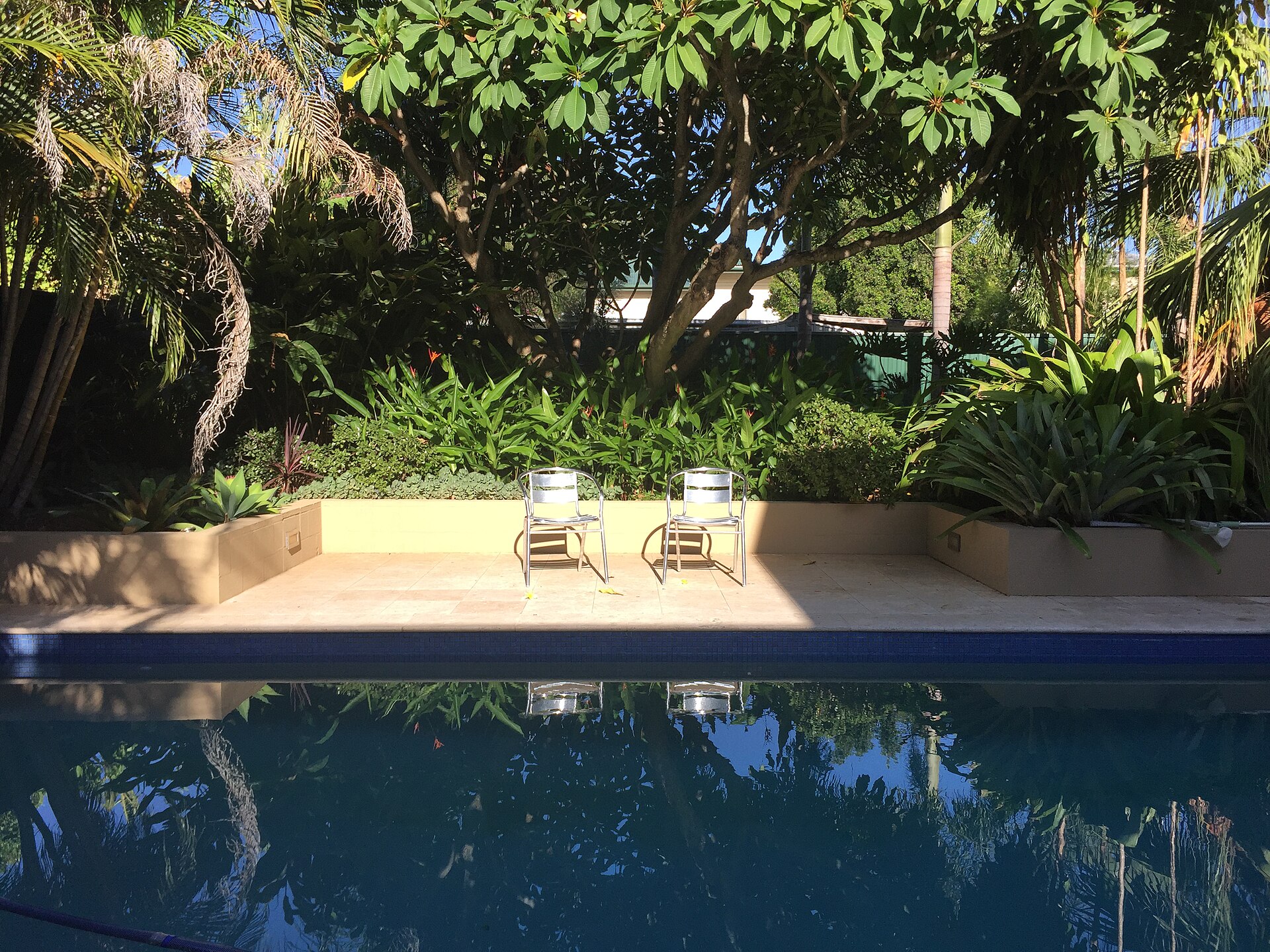
Photo: Kgbo / Wikimedia Commons, CC BY-SA 4.0 · See the image credits page.
A custom pool has two prices, and only one of them is advertised. The first is the shell: excavation, structure, interior, a pump, a filter and a sanitiser on a slab. The second is the dressed pool — the thing you can actually walk out to on a Saturday in December with a legal fence, a gate that latches, paving that does not trip a child, water that is heated if you asked for heat, and a garden that has recovered. Households get into trouble by collecting three quotes for the first number and then discovering the second number in week fourteen.
The cost, compliance and regions problem is not that pools are expensive. It is that the expensive parts are the ones a brochure crops out. Read this as a map of the second number, then go back to the brief and write a budget that includes it.
Shell money and dressed money
Shell-and-equipment packages for a simple concrete rectangle on a flat suburban block still look, in conversation, like a large but containable figure. Add the interior upgrade you actually want, the extra returns, the better sanitiser, the lights, and the figure moves. It is still not the project.
Dressed cost is the project. Coping and paving often rival the interior. A barrier that meets Australian practice on your particular house — glass, aluminium, a masonry return, door alarms, a window change — can land in the same conversation as a small car, or as a kitchen, depending on how invisible you want it. Heating and a cover are optional until the first October you want to swim. Drainage, soakage, a legal overflow, a plant-room door that a technician can use, and the making-good of everything the excavator leaned on are not optional.
Fibreglass changes the shape of the first number and does not abolish the second. A preformed shell can be a cheaper structure; it still needs a hole, a crane or access path, a plinth, equipment, paving and a fence. Vinyl is a smaller part of the Australian custom market and has its own liner-replacement future. Concrete, fibreglass and vinyl is the materials essay. This one only needs you to stop comparing a fibreglass package price to a concrete architectural photograph.
Capital-city bands for 2025 and 2026
Prices move with steel, cement, insurance, labour and how busy the good companies are. They also move with the suburb’s access and the council’s mood. Precise dollars printed on the internet have a half-life of months and a habit of describing a pool nobody would now specify. What follows is a band, dated to the 2025–2026 building climate, not a quote.
In Sydney, Melbourne, Brisbane and Perth, a straightforward custom concrete family pool on an easy site — a rectangle, a pale interior, ordinary paving, a standard barrier, no wet edge — commonly lands, fully dressed, in the low-to-middle hundreds of thousands of dollars. The bottom of that band is the restrained suburban job. The middle is where most architect-adjacent family pools sit once the sandstone is approved.
Adelaide and Hobart can look a little softer on labour and harder on freight. Darwin adds climate and a thinner trades list. None of them is cheap once the fence and paving are real.
Above that band sit the photographs: fully tiled interiors, wet edges, structural glass, a pool that is also a retaining wall. Those jobs run from the upper hundreds of thousands into seven figures without anyone having been dishonest. If that is your folder, do not brief a mid-band budget.
Fibreglass, installed and dressed on an easy site, often lives in a lower band. It is still a five-to-low-six-figure decision once the crane, fence and paving are included. Anyone advertising a complete backyard for the price of a second-hand car is omitting the backyard.
Wet edges, and why they are not a tile upgrade
A wet edge — infinity, knife edge, a perimeter-flow court — is extra structure, waterproofing, a catch tank, hydraulics and plant-room volume. It is not “another two metres of mosaic”. Budget it as a different pool. On a slope it may be the reason the water exists. On a flat block it is often a view-of-the-neighbour’s-roof feature that cost a car.
Automatic covers and flush rollers are cheap compared with a pool and expensive compared with a hardware-aisle blanket. Specify them in the dressed budget or admit you will not have them.
Access is a line item with a personality
A wide side drive in a new estate is one project. A terrace in Paddington, a cut in Fremantle limestone, a Canberra court behind a finished house, a Queenslander on stumps with a 900-millimetre path are different projects. Spoil has to leave. Concrete has to arrive. A fibreglass shell may need a crane over a roof. Steel, pebble and coping all walk or get craned.
Access premiums show up as crane days, traffic control, smaller trucks, weekend pours, demolished and rebuilt fences, and neighbours who have a lawyer. They also show up as design compromises: a smaller shell because the pumped concrete was the only way, or a plant room on the street side because the back corner is unreachable.
If the first site visit does not include someone walking the access path with a tape, the quote is a guess. Tight and sloping blocks have their own essay; the cost version is simply “the dirt has to move”.
Paving, fencing, heating and the other halves
Paving is not a leftover. Travertine, granite, concrete, brick and timber each have a supply cost, a fall, a drainage plan and a slip story. A wide entertaining deck can cost as much as a modest shell. A cheap paver on a poorly compacted edge becomes a trip and a stain. Price the area, not the sample.
Fencing is life safety and approval. Glass on a coastal block is a durability cost as well as a product cost. Aluminium is cheaper and more honest on many suburban sites. Using an existing boundary fence only works when that fence actually meets the standard — height, climbability, the neighbour’s barbecue. Budget for the fence you will be certified on, not the fence in the render.
Heating and covers sit on a wide range. A roller and a bubble blanket is one order of money. A heat pump and a slatted cover is another. Gas plus three-phase plus a roof of collectors is another again. Running cost is a separate, ongoing figure; see the heating essay and do not use a brochure’s winter bill as your own.
Lighting, a shower, a cabana and an outdoor kitchen are not pool costs until they are. If the photograph includes them, they are in the budget.
Contingency, variations and the week the machine hits rock
The first day of excavation is when the site tells the truth. Rock, fill, an unmapped stormwater, a spring, a neighbour’s footing — these are why a contingency exists. A tenth of the dressed budget is a common habit on an easy surveyed site. A sixth is more comfortable on infill, slopes and made ground. It is the money that stops you cheapening the gate when the hole costs more.
Variations should be written. “While you’re here” is how a pool grows a spa and a second pit.
Regional loadings, travel and the thin market
Outside the capitals the shell may be cheaper and the specialist dearer. Travel, accommodation, freight and a thinner trades list are loadings. A wet season that stops a northern pour is a calendar loading. Do not assume a capital-city band applies to a hill behind Cairns or a limestone lot north of Perth without a local builder in the room.
Owner-builder savings vanish if you become the person who owns every gap between contracts.
How to read a quote
Ask what is excluded. The honest list is usually long: fence, gates, paving, coping if not listed, water, gas, power upgrade, council and certifier fees, landscape, irrigation, furniture, cover, heating, chemicals at handover, making good the drive. Ask who lodges the approval and who pays the fees. Ask how many pours, who engineers the steel, and what happens if rock appears.
Compare scopes, not bottom lines. Three numbers for three different pools will produce a fourth pool you did not want.
Then add the dressed items yourself on a single page. If the page scares you, shrink the shell or the finish, not the barrier and not the drainage. A slightly smaller pool that is legal and dry is a better object than a heroic photograph with an IOU on the glass.
The cost of a custom pool is the cost of a small piece of civil work in a garden. Budget like that and the rest of the conversation — shape, climate, region — becomes design again.
Photo: Kgbo / Wikimedia Commons, CC BY-SA 4.0
Questions readers ask
- Why is a dressed pool so much more than the shell quote?
- Because the shell is a hole, steel, concrete and a basic hydraulic circuit. Coping, paving, a compliant barrier, gates, heating, a cover, lighting, drainage and a garden that does not look like a worksite are separate trades and separate money.
- What should I use as a 2025–2026 budget band in a capital city?
- For a straightforward custom concrete pool on an easy suburban site, plan on a low-to-mid six-figure sum once the water is dressed and legal. Architectural wet edges, difficult access and fully tiled interiors sit above that, sometimes well above. Treat any precise internet figure as marketing.
- How much contingency is sensible?
- Enough to absorb rock, wet ground, a service you did not know about, and a barrier detail the certifier will not accept. Many households set aside a tenth to a sixth of the dressed budget. The right number is the one that stops you cheapening the fence when the excavation surprises you.
Found an error? Use the contact form or read how we handle corrections in editorial standards.