Concrete, fibreglass and vinyl pools compared for Australia
Most Australian custom work is still shotcrete. Fibreglass is a mould and a crane. Vinyl exists, but it is not the default backyard and should not be sold as if it were.
Custom Pools editorial team · 4 March 2026 · Updated 18 March 2026 · 18 min read
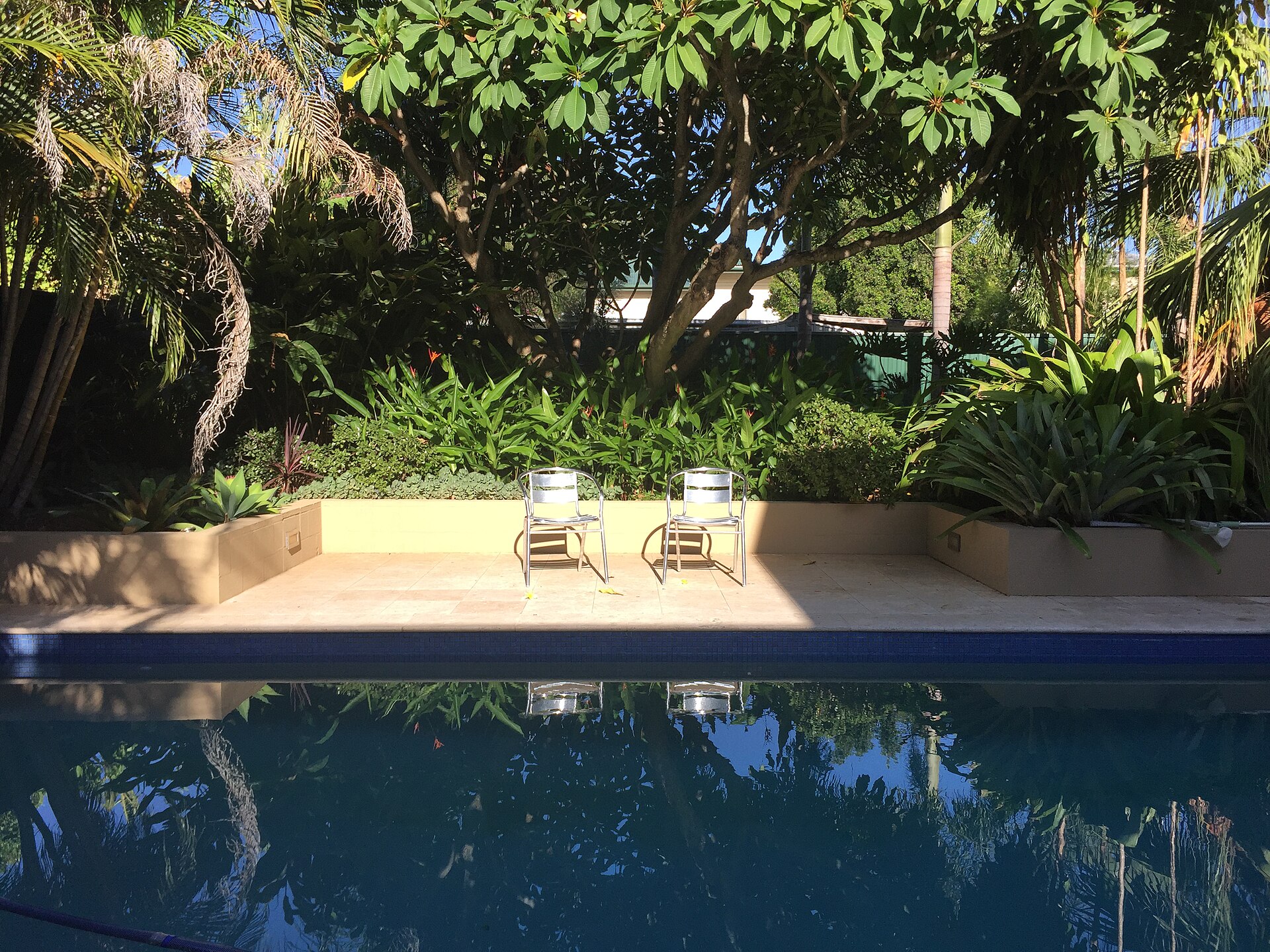
Photo: Kgbo / Wikimedia Commons, CC BY-SA 4.0 · See the image credits page.
Australia does not have one backyard pool. It has a hole that is shotcreted to a drawing, a factory shell that arrives on a float, and a much smaller third path in which a liner is the waterproofing. The construction hub is mostly about the first of those, because that is where custom work still lives. The other two are not inferior so much as different products, and they fail in different ways.
If a quote mixes a moulded shell with a freeform concrete spa and a “vinyl option”, you are not comparing prices. You are comparing structures. Read what actually happens during a custom pool build before a salesperson collapses those differences into a weekly special.
Concrete is a structure you grow on site
A custom concrete pool is a reinforced shell. In Australian yards that almost always means steel fixed in the excavation, then a wet or dry shotcrete mix sprayed against soil, formwork or a stay-in-place profile. The trade still says gunite for the dry-mix tradition and shotcrete for the wet; on a suburban job the distinction that matters is who is shooting, how thick the cover to steel is, and whether the engineer’s drawing survived the afternoon.
Poured concrete — walls and floor cast in formwork, more like a tank — shows up on architectural rectangles, indoor work, and faces that will take a precise tile. It is slower to form and less forgiving of a freeform plan. Most “concrete pool” companies in Sydney, Brisbane and the Gold Coast are shotcrete companies. If a quote says poured, ask what is formed, what is shot, and who inspects the steel.
Either method lets the water be any plan that fits the setbacks. Depth can change. Benches, swim-outs, wet edges and a spa that is part of the shell are ordinary. The interior — pebble, quartz, glass bead, render or a full tile — is a later decision, covered in pool interiors. The vice is the same: you have bought a small civil project. Soils, steel, cure and waterproofing all have to be right, and the calendar is measured in months.
Concrete lasts if the engineer allowed for the soil, the steel has cover, pipes are detailed, and the interior is renewed when it is worn. Hairline shrinkage after a shoot is common and often cosmetic. Structural cracks that open, weep or step come from reactive clay, poor bearing, missing steel, a surcharge from a house footing, or a pool emptied in a high water table without a working hydrostatic valve. Those are excavation and engineering problems a pebble colour will not hide.
Fibreglass is a mould, a truck and a crane
A fibreglass pool is a laminate built on a plug in a factory, then shipped. Australian makers work to the premoulded fibre-reinforced plastics standards; ask which standard the shell is made to and what chemical barrier sits on the laminate. Older shells earned a reputation for osmosis — water moving into the laminate, blisters at the surface. Modern vinyl-ester barriers have reduced that story. They have not abolished it. If you are buying a used shell, or a brand that cannot show how the barrier is specified, treat osmosis as a live risk.
Shape is the first limit. You are choosing from moulds. Some ranges are generous — a family freeform, a rectangular plunge, a lap-ish rectangle with a spa — but you cannot invent a dog-leg to miss a sewer or a shallow terrace that matches a floor level. Semi-custom here means a colour, a gelcoat finish, maybe a different step. It does not mean the designer redrew the water to the survey.
Access is the second limit. Street trees, overhead lines, a narrow inner-west laneway, a battleaxe driveway and a crane pad that is the neighbour’s lawn are all reasons a display-village mould never leaves the truck. Measure the travel path before you fall in love with a twelve-metre rectangle. On a slope the crane becomes a second project; on a tight block the honest answer is often that this shell will not fit.
Install is faster. A straightforward fibreglass job on an easy site can be in the ground and trimmed in a handful of weeks once approvals are done. You still need a level bed, correct backfill, plumbing that matches the mould’s ports, and a barrier the certifier will accept. Speed is not a substitute for compaction. A shell on a soft haunch will print that softness into the waterline.
Vinyl is a skin, and it is rare here for reasons
Vinyl-liner pools are ordinary in parts of North America and uncommon in Australian capitals. They exist: a few yards still build in-ground liners on concrete or steel walls, and portable structures turn up on rentals and farms. The liner is the waterproofing. The structure holds the shape. When the liner fails you replace it; you do not pebble over it.
Australian sun and heat are unkind to a thin polymer skin. Ultraviolet, a dark interior that cooks, and a cover left half-on will age a liner faster than a cold-climate catalogue admits. Typical replacement sits somewhere from the better part of a decade to a decade and a half, not generations. That can be rational on a site you will sell, or where you need a rectangle without a shotcrete crew. It is a poor way to chase a resort photograph. Ask who replaces liners in your city, not only who sells them.
Lifespan is a range, not a warranty slogan
Concrete shells engineered in the 1970s and 1980s are still taking new interiors around Australian suburbs: a decades-long structure with a finish that wants work every decade or two. Careful fibreglass laminates can also serve for decades if the water is balanced and the shell was not cooked empty in January. Poor shells fail earlier. Brand, process and a written barrier specification matter more than a long warranty on a flyer.
Warranties are not lifespans. A structural warranty that excludes movement, hydrostatic damage or “owner neglect” will not help when western clay heaves. Read the exclusions. Ask who holds the insurance if the builder has changed names. Vinyl should be costed as structure plus several liner cycles. If that arithmetic still wins, it wins. If it only wins because the first quote hid the replacement, it does not.
Custom, semi-custom and the catalogue
Custom, here, means the water is drawn for the block. Semi-custom means a standard structure with extras — a spa, a beach, a particular interior. Catalogue means you pick a mould or a package plan. Concrete can be any of the three. A company selling “custom concrete” from three standard rectangles is a package builder, which is a respectable trade if the price and the drawing match. Fibreglass is almost always catalogue or semi-custom. Vinyl follows the wall system you buy.
The cost conversation belongs in what a custom pool costs in Australia. In 2026 a dressed custom concrete pool on an ordinary capital-city block commonly lands in the low-to-mid hundreds of thousands of dollars once paving, barrier and plant are included. A fibreglass package on an easy site can sit well below that. Wet edges, rock, full tile and architectural glass sit above it. Those are bands, not quotes. Concrete is a twelve-to-twenty-plus-week sequence after you may dig. Fibreglass compresses the shell stage and still waits on fencing and commissioning. Vinyl is sold on speed; it still needs a barrier that latches.
How they fail, and what that failure looks like
Concrete’s public fear is cracking. Split cosmetic from structural. Fine shrinkage in a new interior is a conversation with the applicator. A crack that steps the coping, or a floor that lifts after a wet winter, is geotech and steel. Emptying a concrete pool in a high water table without checking the hydrostatic relief is a way to float a shell.
Fibreglass’s public fear is osmosis and a chalky surface. Blisters and a pattern that spreads from a low point want someone who understands laminates, not a new chlorinator. Impact damage should be photographed before backfill. Vinyl’s fear is a hidden leak and a liner that ugly-ages: wrinkles and a split nosing are maintenance; a leak at a wall joint is structure.
Coastal yards add salt to all three. Fittings, bonding and chemistry are a durability problem, not a shell-type slogan. A gelcoat does not excuse cheap ladders. A pebble does not excuse a gate that rusts open.
Choosing without a brochure in your hand
Start with the survey, the access and the use. If the water must be a particular shape, or sit in a terrace that already has levels, concrete is the adult answer. If the site is open, the crane can stand, and you want a known interior with less wet trade on site, fibreglass is a coherent product. If the budget is a hard ceiling and you accept a skin you will replace, vinyl can be named without embarrassment.
Then look at who will still answer the phone in ten years. A custom concrete job is only as good as the engineer, the shooter and the interior crew. A fibreglass job is only as good as the laminate and the people who bed it. A liner job is only as good as the next liner. The construction essays that follow assume you have picked a structure on purpose. Do not pick it because a display village had nicer towels.
Photo: Kgbo / Wikimedia Commons, CC BY-SA 4.0
Questions readers ask
- Which pool type lasts longest in Australia?
- A well-engineered concrete shell with a maintained interior is the one that commonly outlasts the household that commissioned it, often several decades if soils and steel are honest. A modern fibreglass shell can also serve for decades if the laminate and chemical barrier are sound. Vinyl is a replaceable skin on a structure; budget for liner changes rather than a single lifetime surface.
- Can I get a custom shape in fibreglass?
- Only inside a mould catalogue, plus small options such as spa seats or a particular step. If the water must thread a side setback, sit hard against a terrace, or change depth for a genuine lap lane, you are in concrete. Calling a mould “custom” because you chose a colour is sales language.
- Why are vinyl-liner pools uncommon here?
- Heat, ultraviolet and a market already organised around shotcrete and factory shells. A few yards still build liner pools, and they can be the right answer on a tight budget or a temporary structure, but they are not the Australian default and they need a replacement plan.
Found an error? Use the contact form or read how we handle corrections in editorial standards.