Indoor, outdoor and enclosed pools in Australian climates
Closing a pool against weather is a climate-control project, not a glass upgrade. Condensation, corrosion and running cost decide whether the water is a joy in July or a damp room you avoid.
Custom Pools editorial team · 4 November 2025 · Updated 4 November 2025 · 23 min read
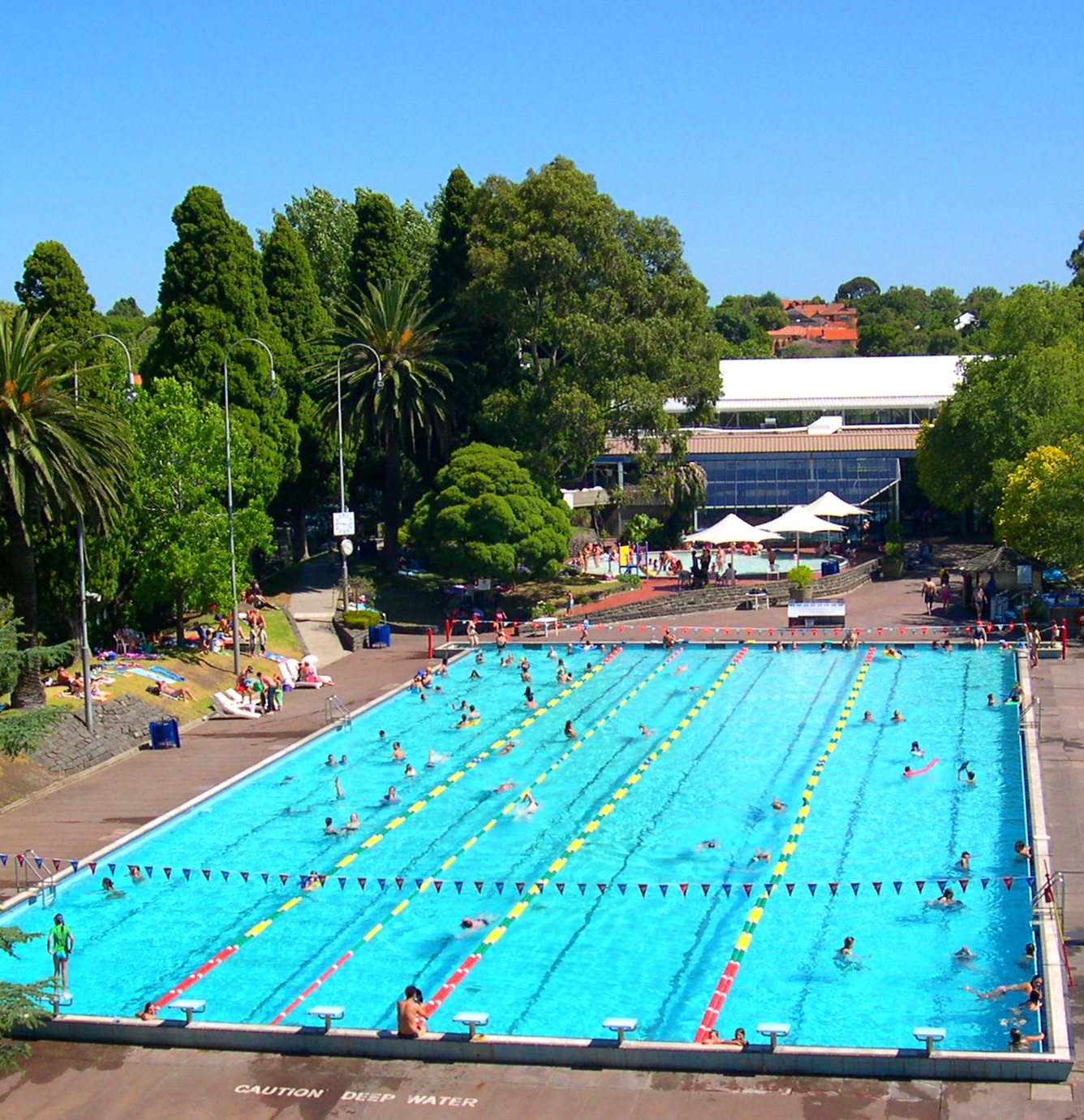
Photo: Lincolnponton / Wikimedia Commons, public domain · See the image credits page.
Australia sells an outdoor life and then delivers a continent of contradictions. Melbourne gives you a week of still autumn days and then a fortnight you would not send a dog into. Canberra will freeze an uncovered pool. Cairns will steam a closed room. Perth will bake an unshaded terrace and then deliver a clear winter that is perfect for swimming if the water is not in the mid-teens.
Households ask for an indoor pool, a glass room they can open, or a living room that steps into the water. Those are three different buildings. Warm water in a closed volume makes weather. If you do not design for that weather, the enclosure becomes a corrosion chamber with a nice view.
This sits beside heating, covers and seasonal care in the water, climate and care hub. Get the climate right first.
Three ways to bring the pool in from the weather
A fully indoor pool
A true indoor pool is a room with a roof, insulated walls, controlled air, and water that does not care what the southerly is doing. Public examples — the Harold Holt Swim Centre among them — make the type look civic and solved. A domestic version is smaller, and it is still environmental engineering.
You gain year-round access and privacy. You lose sky, you lose the garden as the other half of the room, and you take on a permanent energy load. The room must handle evaporation every day of the year. Indoor pools make sense for a household that will train through a southern winter, or for a swimmer who wants privacy on a tight urban lot. They are a poor buy for people who wanted “a bit of cover for the kids”.
An operable enclosure
Retractable roofs and stacking glass walls promise the Australian fantasy: open like a terrace in April, shut like a lodge in July. The good versions do that. The cheap versions leak, rack in the wind, and leave you with a greenhouse that cannot be either fully open or properly sealed.
Operable glass wants a structure that can take the loads, tracks that drain, and a plan for a south-westerly while the roof is open. For every week you keep it shut and heated, it also wants the same dehumidification conversation as a fully indoor pool. Opening the room on a Melbourne winter afternoon does not remove the need for a cover that night. Use an operable enclosure when the site has a season worth opening to, and when you will pay for hardware a specialist will still service in ten years. Do not use it to avoid outdoor shade and a decent cover.
A swim-out from the living room
The third type is not an enclosure of the pool. It is an opening of the house: stacking doors, a continuous floor, and water a metre beyond the threshold. In Queensland and northern New South Wales this is a reasonable way to live if the barrier is designed with the joinery and the floor is a wet area. In a cold climate it is a way to air-condition the garden.
The risks are humidity in the house, chloramines in the curtains, splash on timber, and a barrier that depends on every door latching every time. AS 1926 does not relax because the architect wanted a single room. A swim-out can still be the best Australian version of indoor-outdoor water, because the pool remains an outdoor pool. What you are buying is a threshold, not a climate-control plant.
Condensation is the real brief
Warm water evaporates. Cold glass and cold roof sheeting collect that vapour. In a southern winter the inner face of a single-glazed wall can run with water while the pool looks inviting. That water finds steel lintels, downlights, timber soffits and the laptop someone left on the bench.
Dehumidification is not a portable box from a catalogue. For a dedicated indoor or enclosed pool it is typically a designed system that can handle the water surface, the temperatures and the hours the room is closed. Keep air a little warmer than the water so the glass does not weep. A cover when nobody is swimming is still the cheapest dehumidifier you will own.
Air movement matters as much as the machine. Stagnant corners grow mould. Returns should wash the glass. If the pool is only enclosed in winter, you still design for the closed state. That is when the damage happens.
Corrosion, chemicals and the room as a marine environment
Enclosed pool air is warm, wet and faintly chemical. It attacks ordinary steel, cheap stainless, untreated timber, electrics specified for a living room, and door hardware that looked sculptural in the showroom. Coastal outdoor pools already know this story; indoor pools import it into the building.
Specify the room as a wet, corrosive environment:
- Stainless grades that belong near water, not kitchen grades.
- Coatings and sealants that tolerate humidity.
- Lights and fittings with the right ingress rating, and a lighting design that does not put bare transformers in the damp.
- A floor that drains, including the deck around the water.
- Joinery that can be wiped and does not swell.
Salt systems do not make the air gentle. Indoor air also holds chloramines if ventilation is lazy and the water is dirty with people. That “indoor pool smell” is a sign the water is under-treated or the air is under-changed. A domestic room that ignores this will look tired in a few seasons.
Melbourne winters, tropical humidity, and the lie of one product
Southern capitals
Melbourne, Hobart, Canberra and the cold inland need heat in the water and, if enclosed, heat and dryness in the air. An outdoor pool with a good cover and a heat pump will give you a longer season without a building. Winterising in Melbourne and Canberra is the cheaper first move for households that will not swim every July morning.
If you still want to swim in a southerly, enclose a small pool, not a lagoon. A 4 by 8 metre indoor lane or a compact plunge is a room you can afford to condition. A 12-metre indoor family pool is a small aquatic centre.
Double glaze the enclosure if you can. Insulate the roof. Put a thermal cover on every night. You are heating two bodies: the water and the air. Solar, heat pumps and gas still apply; collectors can help on clear winter days if they see north sky, but they will not replace a designed plant through a grey fortnight.
The tropics and the subtropics
In Cairns, Darwin, Broome and much of coastal Queensland the water does not need a building to stay warm. The air is already wet. Enclosing a pool without serious dehumidification and a way to open the room is how you grow mould on every unsealed surface and rust every fastener.
An operable enclosure that spends the dry season open and the storm hours shut can make sense if the hardware can take the local wind loads. A fully sealed indoor pool in the wet season is a humidity project first. Outdoor shade and a cover against debris are typically more useful than glass.
The middle coast
Sydney, Adelaide and south-east Queensland can justify a swim-out or a partial enclosure more often than a full hall. A stacking wall on the northern side of a compact pool, used as a wind break rather than a sealed box, is often enough. Keep the option to open fully. Budget a cover regardless.
Running cost is a design input
Owners remember the glass quote and forget the bill. An enclosed pool typically asks you to pay for:
- Heating the water, all year if the room is used all year.
- Heating or cooling the air.
- Dehumidification, which is not free electricity.
- More careful filtration, because the garden will not dilute your mistakes.
- Servicing of doors, roofs and plant.
A cover cuts evaporation and therefore the dehumidification load. Lower water temperature cuts energy and moisture in the air. Smaller water is cheaper water. If the running-cost conversation makes you flinch, you want a well-oriented outdoor pool, a cover and honest heating — not a building. Most Australian swimming still happens under the sky.
Light, privacy and the hours you will actually use
An enclosure changes light. Glass that is wonderful at noon can glare at 4pm and weep at 7am. Night lighting inside a glass box turns the pool into a lantern for the street unless you dim it. An indoor pool is also a hard room. Soften what you can without creating mould traps.
Choose the least building that still gets you in the water
Write the months you will swim and the weather that currently stops you. If the answer is “wind and a cool night in April”, you likely need a cover, heating and a wind wall, not a hall. If the answer is “I train at 5.30am through a Canberra winter”, you may need a real indoor room and a designed dehumidifier. If the answer is “we want the living room and the water to be one place in summer”, design a swim-out and a barrier that will still latch when the party is tired.
Enclosure is architecture in a corrosive climate. Treat it with that seriousness and the water can be a winter room. Treat it as a joinery upgrade and the house will smell like a public baths by the third July.
Photo: Lincolnponton / Wikimedia Commons, public domain
Questions readers ask
- Is an operable glass enclosure cheaper to run than a fully indoor pool?
- Typically yes in the shoulder seasons, because you can open the room and use outdoor air. In a Melbourne winter, or any week you keep it shut and heated, you still need dehumidification and you will still pay to heat water and air.
- Can I just stack the living-room doors and treat the pool as indoor-outdoor?
- You can create a swim-out, but the living room then shares humidity, chloramines and splash with the house. The barrier, the floor waste and the joinery have to be designed as a wet room, not as a nice photograph.
- Do tropical indoor pools need less heating?
- Water temperature is often the easy part in the north. Humidity, mould and corrosion are the hard part. Enclosing warm water in a wet season without serious dehumidification is how a beautiful room becomes a greenhouse.
- What fails first in an enclosed pool?
- Typically steel, electronics, timber and cheap hardware, attacked from the inside by warm, wet, faintly chemical air. Specify the room as a corrosive environment, not as a sunroom that happens to hold water.
Found an error? Use the contact form or read how we handle corrections in editorial standards.