Choosing a pool shape for an Australian backyard
The outline of the water is a construction decision first and a style decision second. Australian lots, setbacks and covers punish the wrong geometry.
Custom Pools editorial team · 18 February 2026 · Updated 18 February 2026 · 21 min read
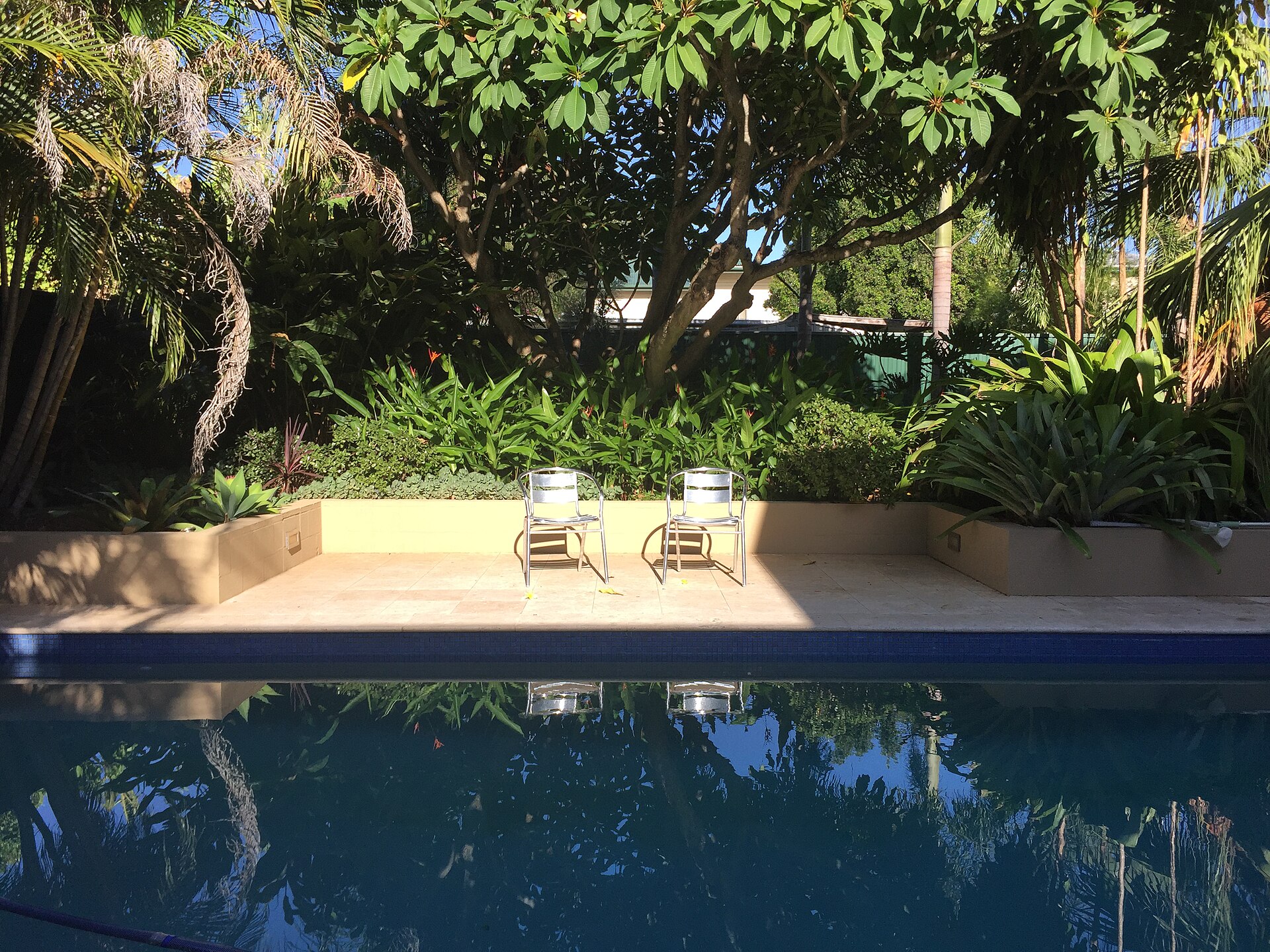
Photo: Kgbo / Wikimedia Commons, CC BY-SA 4.0 · See the image credits page.
Shape is the first drawing most owners fall in love with and the last constraint most of them understand. A kidney from a 1980s display village, a 20-metre lap lane copied from a coastal hotel, and a dark rectangular court flush with the living-room floor are not interchangeable. They excavate differently, they fence differently, and they leave a different garden once the paving band and the plant room have taken their share.
Start from the lot, not the mood board. The rest of the design and planning work only makes sense once the outline is honest about leftover space. If you have not written down who will use the water and in which season, brief the designer properly before you pick a geometry.
What Australian suburban lots actually leave you
A typical inner or middle-ring backyard in Sydney, Melbourne or Brisbane is not a blank rectangle. It is a leftover after the house, the side path, the clothesline and, increasingly, a studio. The usable patch is often eight to twelve metres wide and not much deeper. Add a rear setback, a side setback, a stormwater easement and a 1.2-metre barrier zone, and the water itself may be six or seven metres long before anyone has talked about a sun lounge.
Outer-suburban lots are more generous but not empty. A 15-metre rear garden still has to hold a pool, a lawn, a clothesline that is not a climbing zone, and a path a mower can follow. The mistake is to draw the largest pool that fits inside the setbacks and then discover there is nowhere to sit.
Walk the setbacks with a tape before anyone sketches. Councils typically measure to the waterline or to the structure. None of them give you the paving for free. A 600-millimetre coping band around a 4 by 8 metre rectangle is already a bigger hole than the water suggests. Sit a table on one long side and the band becomes two metres.
On a slope or a battleaxe, shape is not a style choice at all. Read custom pools on sloping and tight blocks before you commit to a long axis that can only be excavated from the neighbour’s side.
Rectangles: why they still win
A rectangle is not a failure of imagination. It is the geometry that Australian trades, covers and barriers already know how to finish well.
- Straight walls mean straight formwork, predictable steel and a hopper that can sit in one corner.
- A rectangular thermal cover rolls onto a bench or into a hidden trough.
- Glass fencing can run parallel to the water and still leave a usable strip of paving.
- A robotic cleaner has a job it understands, and heated volume is easy to calculate.
On a north-facing suburban lot a 3.5 by 8 metre rectangle with a shallow shelf at the house end will typically get more use than an 11-metre statement that leaves no lawn. The shelf is where toddlers stand, where adults sit, and where the household enters the water without a ladder ceremony. Keep the deep end modest unless someone is actually diving. Extra depth is extra excavation, extra water and extra heat.
A rectangle also photographs as architecture. Dark interior, thin coping, one long view from the kitchen: that is a court, not a recreation lagoon. If that is what you want, say so in the brief. Do not then add a beach entry and a curved spa that fight the line.
Freeform and the kidney problem
Freeform water has a place. A garden that already has a sandstone outcrop, a jacaranda you will not cut, or a creek-line planting can accept a curve that follows the land. The curve should come from the survey and the trees, not from a template labelled “lagoon”.
What freeform rarely does well on a standard lot is the rest of the project. A kidney steals the corners you needed for a table. It forces a custom cover that costs more and is harder to put on after a late swim. The roller has no straight wall to hide against. The fence still wants to be a rectangle, so you fence a larger area than the water occupies and the lawn dies in the leftover slivers. Excavation is slower because the machine cannot run a simple box.
If you still want a soft edge, consider a rectangular shell with a planted wet edge or a single radius on the far corner. The water can feel informal once landscaping around the pool does the softening. Plants are cheaper to revise than concrete.
Lap pools, and the length people pretend they need
A true lap pool is a training tool. It wants length, a consistent depth, a quiet return and a wall you can flip on. Twenty metres is a proper short course; fifteen metres is a compromise that still works for fitness if the household will actually swim laps. Anything shorter is a long plunge, and that is fine if you stop calling it a lap pool.
The problem on Australian lots is the axis. A 15-metre lane down a side setback can work beside a terrace house if access, services and the barrier can travel with it. Across a typical rear garden it often eats the only north-facing lawn. Side-yard laps also collect leaf litter from two boundaries and can sit in shade for half the day.
Ask who will train and how often. A 10-metre rectangle with a bench and honest heating will be used more than an 18-metre lane that makes every other outdoor activity impossible.
L-shapes and plunge pools
An L-shape is two rooms of water. One leg can be a long swim; the other a play shelf, a spa, or a shallow court against the house. On a corner lot or a garden that wraps an existing patio, the L can occupy leftover space that a single rectangle would waste.
It is also two sets of costs. Extra corners mean extra formwork and pebble cuts, and a cover that is either two pieces or a custom cut. Hydraulics have to turn the corner without dead spots. Fencing can follow the L and become a maze of gates, or box the whole thing and surrender the inner lawn. Use an L when the house already makes the corner. A slightly shorter rectangle with a raised spa on the end is often cleaner.
A plunge is a deep, compact body of water for cooling and a few strokes, typically in the 3 to 6 metre range. It suits inner-urban courtyards and gardens that must keep a real lawn. A small dark plunge in western sun can feel like a bath by 3pm unless you have shade and a cover; a pale one in full shade can sit cold and grow algae. Be honest about the users: a plunge next to a living-room slider can be the best pool on a tight lot, and a poor choice if the household wanted children to learn to swim.
How shape spends money you cannot see on the sketch
Excavation and structure
A simple box is a simple hole. Curves, hops in depth, spas above the main water and wet-edge troughs all change the excavation, the steel and the engineer’s interest. On clay, a bigger or more articulated hole is more soil to cart. On sand, it is more temporary support. On rock, every extra metre of length is a day you did not budget. Shape is a civil decision.
Covers, rollers and the afternoon you will not bother
If you intend to heat, a cover is not optional decoration. Rectangular bubble or slat covers are a known product. Freeform covers are a special order. An L-shape often needs two covers. A raised spa needs its own lid.
Then there is the roller. It wants a straight wall, a hidden trench, or a piece of paving you will never put a chair on. Owners who skip this conversation discover that the only place the roller can live is in front of the outdoor kitchen. Draw the roller the same week you draw the water.
Fencing and the barrier zone
Australian pool barriers follow AS 1926 and the state rules that sit on top of it. They do not follow the romance of the waterline.
- A curved pool inside a rectangular fence wastes the corners.
- A pool that nuzzles the boundary may force the neighbour’s fence to become the barrier.
- Windows and doors that open toward the water become part of the shape conversation, because the barrier may have to sit on the house.
- Extra gates from an L-shape or a wrapping fence are gates children will prop open.
Glass on every side looks simple in a twilight photograph. It still needs a latching gate, a non-climb zone, and a maintenance budget.
A working method, not a favourite silhouette
Write the uses. Measure the leftover garden after setbacks, paving, plant room and a table. Choose the simplest outline that holds those uses. Test a rectangle first, then an L if the house already turns a corner, then a plunge if the lot is tight, then a lap if someone will train, and only then a freeform if the land itself is already curved.
Take that outline back to the brief. If the designer cannot explain how the cover, the roller, the fence and the excavation all live with that shape, the drawing is not finished. The pretty water is the easy part.
Photo: Kgbo / Wikimedia Commons, CC BY-SA 4.0
Questions readers ask
- Is a rectangle always the cheapest custom shape?
- Typically yes on an open suburban lot, because formwork, steel, excavation and covers all prefer straight lines. On a tight or irregular block a shorter L-shape or plunge can still cost less than forcing a long rectangle into the wrong leftover space.
- Can I put a kidney or freeform pool on a standard quarter-acre?
- You can, but the curves usually steal usable lawn and make a thermal cover awkward. Freeform earns its keep on an organic garden or a rock outcrop, not as a default from an old brochure.
- How much paving should I allow around the water?
- Plan a continuous band you can walk, typically 600 millimetres or more, plus extra width where people sit, towel off or store a roller. Setbacks are measured to the water or structure depending on the council, so the paving band is not free space.
- Does shape change the fence and the cover?
- Yes. Straight sides take a rectangular slat or bubble cover and a tidy roller. Curves force a custom cover or none at all. Fencing follows the barrier zone, not the waterline, so a wiggly pool can still sit inside a rectangular cage that wastes the garden.
Found an error? Use the contact form or read how we handle corrections in editorial standards.